 listicle
Essential Gaming Accessories for a Pro Setup in 2026
Table of Contents
- Quick Comparison: Essential Gaming Accessories for a Pro Setup
- Ergonomic Gaming Mouse Features That Define Pro-Grade Performance
- Best Mechanical Gaming Keyboards for Competitive Play
- Gaming Headsets With Surround Sound and Noise Cancellation
- Gaming Desk Cable Management Tips for a Clean, Pro Look
- Monitor Arms, Bias Lighting, and Desk Real Estate
- Seating, Acoustic Treatment, and Software Optimization
- How to Choose the Right Gaming Accessories for Your Setup
- Frequently Asked Questions
Last Updated: September 16, 2026
Quick Comparison: Essential Gaming Accessories for a Pro Setup
Building a pro gaming setup starts with four core upgrades: an optical-sensor mouse, a mechanical keyboard, a surround-sound headset, and disciplined cable management.
| Accessory | Top Pick | Key Spec | Best For |
|---|---|---|---|
| Ergonomic mouse | Razer DeathAdder V3 Pro | 30K optical sensor, 63g | Long sessions, palm grip |
| Mechanical keyboard | Corsair K70 MAX RGB | Adjustable magnetic switches | Competitive play |
| Wireless headset | HyperX Cloud Alpha Wireless | 300-hour battery | Marathon sessions |
| ANC headset | SteelSeries Arctis Nova Pro | Active noise cancellation | Cross-platform play |
| Stream control | Elgato Stream Deck MK.2 | 15 LCD keys | Streaming and macros |
| Desk mat | Razer Strider Chroma | 19 RGB zones | Tracking consistency |
| Seating | Secretlab TITAN Evo | 4-way lumbar support | Posture support |
Ergonomic Gaming Mouse Features That Define Pro-Grade Performance
An ergonomic gaming mouse is a pointing device shaped to support the natural angle of your wrist and grip, paired with a high-precision optical sensor for accurate tracking. The two specs that matter most are weight and sensor resolution.
Best Mechanical Gaming Keyboards for Competitive Play
The best mechanical gaming keyboards for competitive play use switches with adjustable or fast actuation, letting you register inputs sooner than a standard membrane board allows. Two designs dominate that category.
Gaming Headsets With Surround Sound and Noise Cancellation
Surround sound gaming headsets place audio cues directionally, so footsteps and reloads tell you where opponents are before they appear on screen. Noise cancellation then removes the room noise that masks those cues.
Gaming Desk Cable Management Tips for a Clean, Pro Look
Clean cable management is the difference between a desk that looks professional on stream and one that looks like a rat's nest. For a pro setup, the goal is not just aesthetics: it is strain relief on connectors, predictable serviceability when you swap a peripheral mid-season, and separation of power from signal so a wireless dongle never drops mid-match.
The pro-grade hardware layer
Most guides stop at hook-and-loop ties. A competitive desk usually adds three pieces of hardware that do the real work:
- Under-desk cable tray, a metal or ABS tray screwed to the underside of the desk. It hides the power strip, the monitor power bricks, and the USB hub in one place. Look for one at least 24 inches long with ventilation slots so bricks do not cook.
- Adhesive cable raceway (cord cover), a paintable channel that runs down the back leg of the desk to the floor. It keeps the drop from the tray to the wall outlet from becoming a trip hazard on stream.
- Velcro one-wrap straps, reusable hook-and-loop ties cut to length. Zip ties are a one-way decision; many find them regrettable within a month when rebuilding a desk.
Routing rules that actually matter
- Route every cable along a single spine, usually the back edge of the desk, and keep the spine behind the monitor arm clamp so it is invisible from the front.
- Separate power runs from data and antenna runs. Run them on opposite sides of the tray, or cross them at 90 degrees if they must intersect.
- Leave a service loop of 6-12 inches at every device so you can pull a keyboard or headset forward without unplugging anything.
- Label both ends of every cable with a wrap-around tag before you hide it. Future-you will thank present-you during a mid-season swap.
- Re-check routing after any hardware change. A new monitor arm or a second display almost always breaks the old spine.
Streaming-specific routing
If the desk is also a streaming desk, two extra runs matter. First, keep the microphone cable on its own path away from the monitor power brick; balanced XLR cables are resistant to interference, but unbalanced USB mics are not. Second, run a dedicated USB extension to the front edge of the desk for a Stream Deck or controller so you are not reaching behind the tray every time you plug in.
A pro cable job is not about hiding wires. It is about making every connection serviceable in under a minute, keeping power away from signal, and leaving enough slack that a hardware swap does not turn into a full teardown.
Monitor Arms, Bias Lighting, and Desk Real Estate
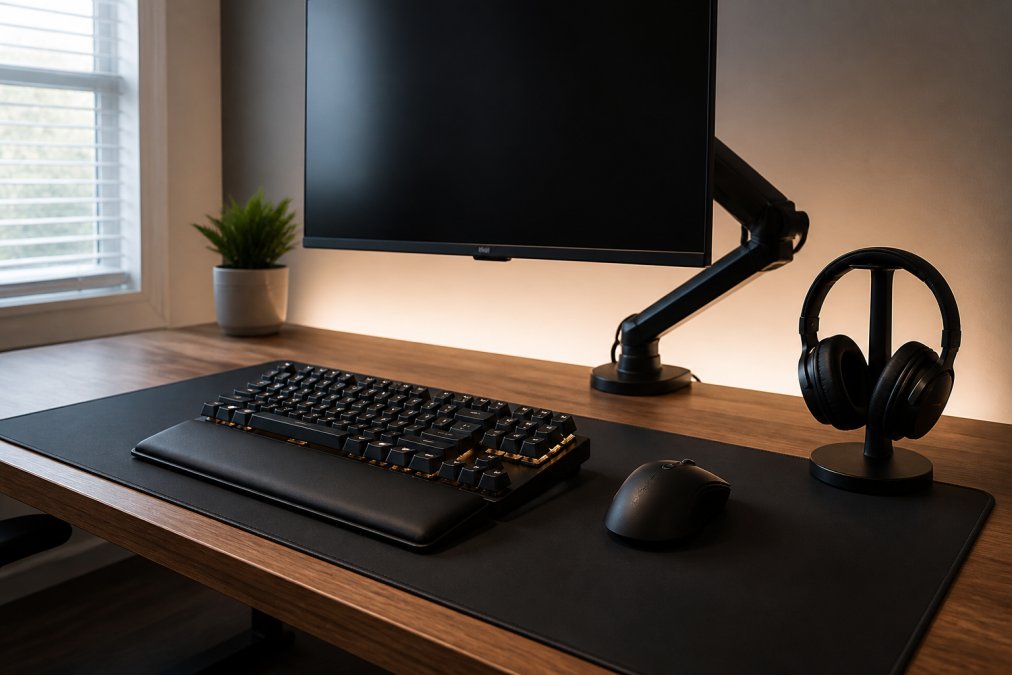
A monitor arm clamps to the desk and holds your display at eye level, which frees the space a stock stand would occupy and lets you dial in posture. For a dual-monitor configuration, arms are the only way to align two panels precisely without a bulky shared base.
Mount the monitor first, then set bias lighting to match. Getting the panel at eye level fixes posture; the lighting just makes the long sessions comfortable.
Seating, Acoustic Treatment, and Software Optimization
A gaming chair with real lumbar support, acoustic treatment for the room, and a disciplined software stack are the three upgrades most pro gaming setup builds skip, and all three affect performance more than another RGB strip. Competitors list hardware and stop; this section covers the environment and the software layer that turn a good desk into a pro one.
Seating: support over style
The Secretlab TITAN Evo addresses the ergonomics side. Its 4-way L-ADAPT lumbar system adjusts up, down, in, and out independently, cold-cure foam holds its shape over multi-hour sessions, and the magnetic memory foam head pillow stays where you put it. It costs $549.00 and takes time to assemble, but the adjustability holds up over years. The tradeoff is that a racing-style chair is not the same as a task chair; if you split time between gaming and desk work, try before you buy.
Acoustic treatment: the upgrade nobody lists
Hard, bare walls bounce sound and smear positional audio, so a headset with surround sound can only do so much. Absorptive panels behind the monitor and in the corners reduce that reflection, which sharpens the directional cues your headset is trying to deliver. This is the single biggest gap in every competitor listicle: they sell you a $349.99 headset and never mention that the room is fighting it.
A practical starter treatment:
- First reflection points, the wall directly behind the monitor and the side walls at ear height. Two to four 2-inch thick absorptive panels cover most small rooms.
- Corners, bass traps in the vertical corners reduce low-frequency buildup that makes footsteps and explosions muddy.
- Floor, a rug under the desk cuts the slap between a hard floor and the desk surface.
- Door and window, a heavy curtain or a door seal reduces outside noise leaking into an open mic during a stream.
Software optimization: the free performance layer
Software is the accessory nobody sells you, and it is often worth more than the next hardware upgrade.
- Peripheral firmware and drivers, keep mouse, keyboard, and headset firmware current. Vendors ship polling-rate and latency fixes through firmware updates, not new hardware.
- Macro and profile managers, a Stream Deck MK.2 or a vendor utility like iCUE or G HUB lets you bind game-specific profiles, so switching titles does not mean re-binding keys by hand.
- Lighting sync, one sync utility (Razer Synapse, Corsair iCUE, or SignalRGB) across keyboard, mouse mat, and bias lighting prevents three background apps from fighting over the same USB bus.
- Audio equalizers, a system-level EQ or a headset's companion software lets you lift footstep frequencies and cut boomy lows, which is often more effective than buying a more expensive headset.
- Background process discipline, disable startup apps that compete for CPU cycles and close browser tabs during ranked play. Software-based optimization often recovers frame rate that no hardware purchase will.
Before buying any new peripheral, spend one evening updating firmware, trimming startup apps, and setting a game-specific audio EQ. It is free, it is reversible, and it frequently closes the gap you were about to spend money on.
Seating fixes your body, acoustic treatment fixes your room, and software fixes your system. None of the three shows up in a typical accessory list, and all three compound with every piece of hardware you already own.
How to Choose the Right Gaming Accessories for Your Setup
Choosing the right accessories comes down to three questions: what you play, how long you sit, and what your desk can hold. Answer those and the shortlist narrows fast.
- Competitive FPS: prioritize mouse weight and sensor, then keyboard actuation
- Streaming: add a Stream Deck MK.2 for macros and scene control, plus a headset with a clean mic
- Long sessions: invest in seating and a headset with strong battery life before more lighting
- Multi-device: pick a headset with a base station that switches between PC and console
- Budget-to-pro path: upgrade the mouse and keyboard first, then seating, then acoustic treatment
Frequently Asked Questions
What are the most important accessories for a professional gaming setup?
A pro gaming setup starts with four core peripherals: a high-precision gaming mouse, a mechanical keyboard with low actuation force, a headset with surround sound and noise cancellation, and a large desk mat for consistent tracking. From there, add a monitor arm to free up desktop real estate, bias lighting to reduce eye strain, and cable management to keep the workspace clean. Each piece builds on the last, so prioritize the mouse and keyboard first, then expand.
Do gaming accessories actually improve performance?
Yes, when they address a specific bottleneck. A mouse with a high-precision optical sensor and low input lag reduces tracking errors in FPS games. A mechanical keyboard with adjustable actuation lets you trigger inputs faster. A headset with surround sound and noise cancellation helps you hear footsteps and callouts more clearly. Accessories do not replace skill, but they remove hardware limitations that hold skilled players back.
Are wireless gaming accessories reliable for competitive play?
Modern wireless connectivity has closed the gap with wired. Technologies like LIGHTSPEED and HyperSpeed deliver polling rates and latency figures that rival wired connections. Battery life is the main trade-off: some mice last up to 95 hours, while certain headsets reach 300 hours on a single charge. For competitive play, pick wireless gear with a dedicated low-latency mode and keep a spare cable or battery on hand.
How do I organize my gaming desk for a professional look?
Start with a monitor arm to lift your display and reclaim desktop real estate. Route cables behind the desk using adhesive clips or an under-desk tray, then bundle them with velcro ties. Add a large desk mat to unify the mouse and keyboard zone, and place a headset stand within arm's reach. Bias lighting behind the monitor adds depth and reduces eye fatigue. A clean layout is not just aesthetic; it keeps your peripherals positioned consistently for every session.
The hard part isn't buying gear; it's buying the right gear in the right order. NovexaTech LLC curates premium electronics, gaming gear, and smart home devices so you can build a setup that performs and looks the part, from high-performance controllers and wireless audio to functional home decor. Get started with NovexaTech LLC and upgrade your desk with gear chosen for how you actually play.